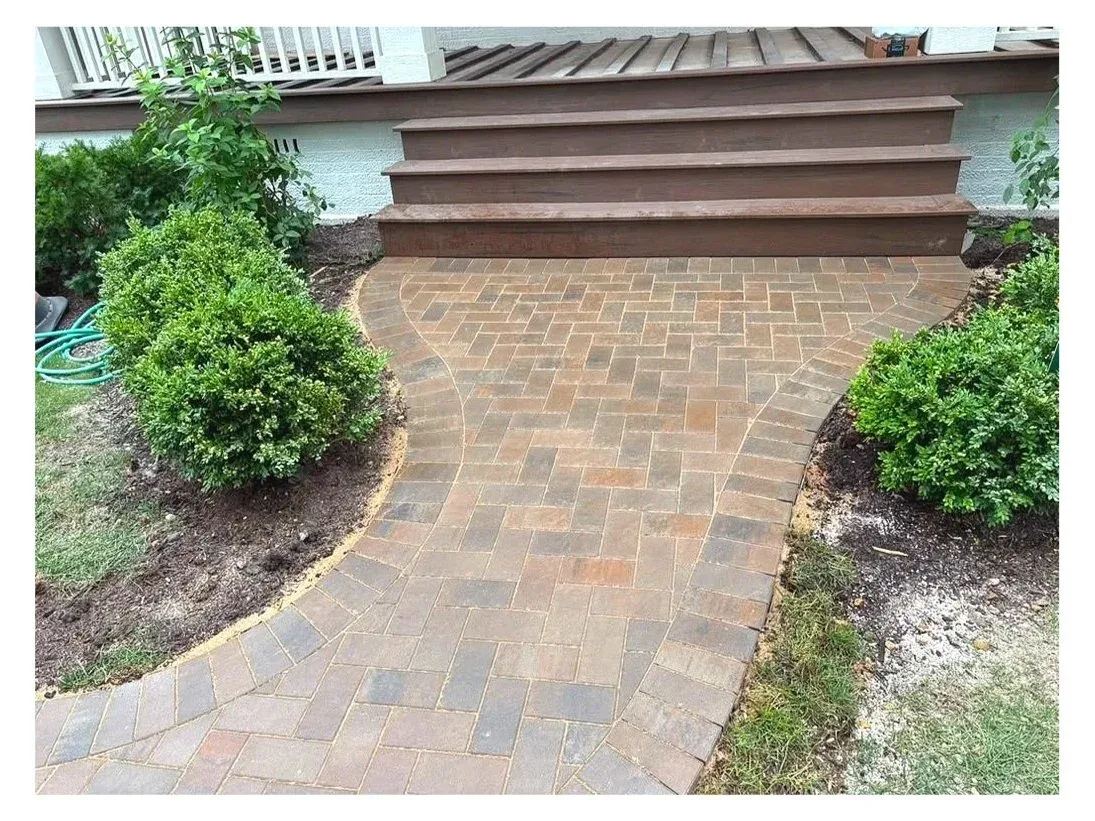
If you drive around Harvard, Crystal Lake or Marengo and look at paver patios that are eight or ten years old, you will see the same failures over and over. A dip near the middle. A wavy edge where the outside row has crept outward. Joints wide enough to grow weeds in. Steps that no longer sit level with the landing.
The pavers are almost never the problem. Concrete pavers are extremely durable. What fails is what nobody sees.
One: the base was too thin
This is the big one. A paver patio is a flexible pavement, which means it does not span anything. It transfers every load straight down. If the compacted aggregate underneath is four inches where it should have been more, or if it was dumped in one lift and rolled once instead of built up in layers and compacted between each one, the patio will settle unevenly. Not immediately. Usually in year three or four.
Base depth depends on the soil and on what the surface has to carry. A lot of northern Illinois sits on clay, which holds water and moves more than sandy soil does. That argues for more base, not less.
Two: nothing was done about water
Water is what turns a small problem into a failed patio. It gets under the surface, and then it freezes.
Northern Illinois does not freeze once in December and thaw once in March. It cycles, repeatedly, all winter. Every cycle expands the water in the base and lifts whatever is above it. That is frost heave, and it is why a patio installed in Georgia and a patio installed in Harvard are not the same build.
Two things reduce it: a base that drains rather than holding water, and a surface pitched so runoff leaves instead of pooling and soaking in.
Three: no edge restraint
A paver field is held together by friction between the units and the sand in the joints. It stays tight because something around the perimeter stops the outside row from moving.
Take that away and the edges migrate outward, a little each season. The joints widen. Sand washes out of the widened joints, so the units lock together less, so they move more. Once it starts it accelerates, and the fix is to take up the perimeter and rebuild it.
Edge restraint is a small line item. Leaving it off is one of the most expensive savings available.
What a proper build looks like
The order matters more than any single material choice.
- Excavate to the depth the soil and the use actually require, not to whatever is quick.
- Build the base in lifts, compacting each one before the next goes on. This is the slow part of the job and the part that decides everything.
- Screed a bedding layer to a consistent thickness, set to the pitch you want.
- Lay the pavers to the pattern, with clean cuts at the edges.
- Install edge restraint around the entire perimeter.
- Sweep in joint sand and compact so the units lock to each other.
None of this is exotic. It is just work that takes time and does not show up in a photograph. Which is exactly why it is the first thing cut when a price gets squeezed.
The honest test before you hire anyone
Ask what the base build is: how deep, and how many lifts. Ask where the water is going to go. Ask whether edge restraint is included.
A contractor who answers those three easily is telling you they have thought about the parts that fail. One who moves quickly to paver colours and patterns is telling you something too.
If you are planning a patio, walkway or patio extension anywhere across northern Illinois or southern Wisconsin, call Panther Landscape and Concrete and we will come walk the site with you. Consultations and estimates are free, and we answer in English and Spanish.
Ready to Transform Your Outdoor Space?
Get a free consultation and estimate from a family operated northern Illinois and southern Wisconsin landscaping and concrete business.